
What Anonymous Poker Hides and What Players Still See

Anonymous poker removes the stable table identity that opponents would otherwise use to connect one hand with the next. The cards, bets, and positions remain visible, so observation does not disappear. The change concerns how long an observation can follow the same person. A public screen name may build a history across sessions; a temporary seat number may last only for one table or event. Anonymous play therefore shortens the lifespan of a read without erasing the information available during the current hand.
In November 2025, TechCrunch reported on a group nickname feature for Facebook. Members could post under a custom username instead of the name on their main profile. The feature hid a member’s main profile from ordinary group members while preserving a complete post history under the nickname and seven days of comments and reactions. Other members could attach later behavior to the same label without knowing the person’s offline identity. At a poker table, opponents can build a lasting read only when they recognize the same public identity after the table, session, or tournament stage changes.
How Long Does a Poker Identity Last?
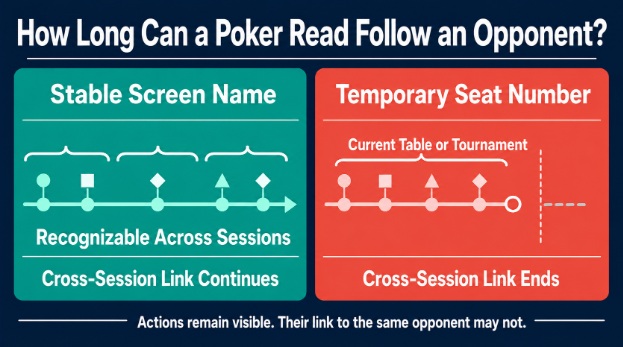
A screen name is a public alias that opponents can recognize later, while a seat number gives the other players far less information to work with. Reads persist only as long as opponents can identify who they are playing against. At regular tables, a familiar screen name allows players to gather information about every other player's style based on past actions. With anonymous poker sites, the evidence window is narrower: the current hand, the current table, or, when one number remains visible, the current tournament.
Cash-table anonymity prevents opponents from building a long-term profile around a stable public name. Tournament play can preserve continuity because one number may stay with a player throughout the event. Betting patterns and position-based habits can still be observed during that tournament, but they cannot automatically be assigned to the same person in a later session.
Position, bet size, board texture, stack size, and action order remain available, even when screen names do not. A short video on position, board reading, and opponent behavior discusses how these factors affect the game, and much of this still carries over into anonymous tables. A late-position raise still differs from an early-position raise, while a check followed by a large bet still creates a sequence the table can evaluate. The missing screen name limits how far that sequence travels; it does not remove the sequence itself. Timing within the hand remains visible too, although connection quality and deliberate pauses can make a single timing tell unreliable.
The Same Action Creates Different Evidence
Suppose seat 4 opens from late position three times in an hour, bets two flops, then checks back a weak showdown hand. During that session, those actions support a tentative read of frequent late-position aggression. If seat 4 keeps the same number throughout a tournament, the read can be revised when the players meet again. A later fold against resistance may weaken it; another aggressive open may strengthen it. Once the number can no longer be connected to the same person, carrying the read forward would attach old evidence to an unknown opponent.
Give the same player a stable screen name, and the actions acquire a longer shelf life. An opponent may remember the name next week or combine it with notes from several sessions. That extra history is still not proof about whether the player is bluffing this time, but it can be useful all the same. A persistent alias allows more evidence to accumulate, but it can also preserve conclusions after the conditions that produced them have changed.
Reads Need Expiration Dates
Treat each read as a note with a boundary. “Seat 4 opened late three times at this table” records both the action and its setting. “Seat 4 is always loose” drops the limits and turns a short sample into a fixed identity. Current-table observations can guide later hands at the same table. A tournament number permits updates during the event. When the label changes or disappears, the player-specific note should expire with it.
Past Choices Can Color New Decisions
History can influence judgment, even when the current situation supplies fresh evidence. A 2025 PLOS Biology experiment on perceptual decisions found that participants showed individual choice-history biases, tending toward either repetition or alternation. This is useful information to keep in mind when playing poker, but also be aware that a familiar screen name can make earlier impressions easier to recall, so a weak pattern may survive longer than the sample warrants.
At an anonymous table, a useful read stays tied to a hand, table, session, or tournament. Record what happened, keep the conditions attached, and reset when the identifier stops being dependable. The cards and betting sequence remain visible; only the public history attached to the opponent has been shortened.
By GamesAndCasinoRelated News
-
Read Full Article
 Games & Casino News
IGT Passes CAD$100 Million Powerbucks Milestone as Wheel of Fortune Millionaire Count Tops 1,200
IGT reported four million-dollar-plus jackpot wins across its progressive slot networks in April 2026, including a Megabucks prize worth more than $10.48 million, while its Canadian Powerbucks network passed CAD$100 million in cumulative jackpot payouts.
-
Read Full Article
 Poker News
From Short Stack to Showstopper: Jose Garcia Etches His Name Into RGPS Austin History
Poker is not an easy game to play, by no means. And just when Garcia thought he didn't have it in him anymore, he came back swinging. It was an event that will forever go down in history.
-
Read Full Article
 Gambling News
Playtech Amplifies European Presence with Svenska Spel
Renowned gaming technology enterprise Playtech is stepping up its influence in the European landscape by cementing a dynamic partnership with Svenska Spel Sport & Casino, the Swedish online gambling giant.
