State Restrictions Reshape Where Sweepstakes Casino Players Can Access Features
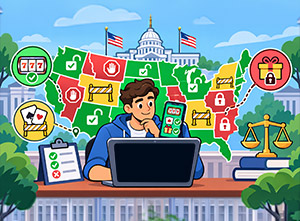
The US sweepstakes casino map has changed quickly over the past 18 months, with more states banning or restricting dual-currency play while others continue to allow it.
For players, that means access can now depend not only on where they live, but also on where they are physically located when they log in.
The distinction is becoming more important as state laws, enforcement actions and operator policies continue to change. A platform may still load normally even when certain sweepstakes features are unavailable.
That makes current state-by-state information more useful than broad claims that a social casino is simply “available in the US.”
One Website Can Offer Different State Experiences
The United States does not treat every form of online gaming as one nationwide market.
State laws, regulatory interpretations and individual operator policies all influence where different products are offered.
Social casinos sit in a particularly complicated part of that landscape because many combine free-to-play casino-style entertainment with sweepstakes features where permitted.
For players, the practical question is usually straightforward: what can actually be accessed from the state they are currently in?
Zula Casino’s current guide, for example, lists full availability in 35 states and restrictions in 15. Some restricted locations may still permit social play while limiting sweepstakes-related features.
An up-to-date guide to social casino legal states can therefore be more useful than relying on an old search result or forum post.
Website Access Is Not the Same as Eligibility
This is where players can get tripped up.
Opening a homepage proves only that the website itself is reachable. It does not automatically confirm eligibility for every game mode, promotion or virtual currency feature attached to the platform.
California provides a useful example.
Zula’s support documentation says players located in California moved to social-platform-only access beginning December 22, 2025, following changes affecting sweepstakes play.
The website itself did not need to disappear for that distinction to matter.
The same principle applies elsewhere. A sportsbook, poker room, social casino and conventional online casino can all have different geographic footprints even when they are operated by recognizable national brands.
Checking the current eligibility page is therefore more useful than assuming that access to the homepage means every feature is available.
Bans, Restrictions and Operator Withdrawals Are Not the Same Thing
One reason state maps can be confusing is that not every restricted state reached that position in the same way.
Some states have passed laws specifically targeting dual-currency sweepstakes casinos.
Others rely on existing gambling law or enforcement action.
Platforms can also decide to withdraw features voluntarily if they believe the legal position is uncertain.
For players, the result may look similar: a feature is no longer available.
But the reason behind that restriction matters because it can determine whether access is likely to change again.
A statutory ban may remain in place until lawmakers amend it. An operator policy can change much more quickly.
Traveling Can Change What You See
Home state and current location are not always the same thing.
Someone who regularly uses a gaming platform in one state might cross into another during a holiday or business trip and find that certain features are no longer accessible.
Zula’s current guidance notes that access can depend on where the player is physically located.
That makes state availability relevant even to people who have already registered.
A cross-country road trip is an obvious example, but the same issue can arise during a weekend away. In some parts of the country, crossing a state border takes less time than driving across a major metropolitan area.
The account has not moved.
The player has.
Old State Lists Age Quickly
Legal and availability information can become outdated quickly.
State legislatures revisit sweepstakes models, regulators change their interpretations and operators sometimes adjust their own geographic policies before casual users notice anything has changed.
That means a state list from last year should not automatically be treated as current.
It is worth checking the publication date and, where possible, going back to the operator’s own eligibility information before participating.
The important question is not whether a platform operated in a state at some point.
It is whether the relevant features are available there now.
This is also why broad statements that social casinos are universally legal or illegal across the US are rarely useful.
The reality is much more granular.
Look Beyond the Green or Red Map
State maps are convenient, but the notes underneath them matter just as much.
Players should check whether “restricted” means the entire platform is unavailable or only certain modes are affected.
Age requirements and account-verification rules also vary, while travel can introduce another layer if the platform bases access on current physical location.
Zula’s guide separates full availability from more limited social-only access, illustrating why state eligibility is not always a simple yes-or-no question.
It only takes a minute to check.
That is a better use of time than discovering halfway through registration that the feature you wanted is not offered where you are.
The State Map Is Still Changing
The broader trend is clear: sweepstakes casino availability is becoming more fragmented.
As more states take action and operators adjust their own policies, players cannot assume that access will remain the same from one year to the next.
For social casino users, the most useful habit is therefore not memorizing a fixed list of permitted states.
It is checking the current rules whenever location changes, especially before signing up, returning after a long break or traveling across state lines.
By GamesandCasinoRelated News
-
Read Full Article
 Games & Casino News
Booming Buffalo: Extreme 2 Enhances Slot Experience
Discover Booming Buffalo Extreme 2's thrilling Hold and Win mechanics and bonus features, offering up to 12,000x wins.
-
Read Full Article
 Games & Casino News
Peter & Sons Expands Gaming Reach in Europe with SYNOT Partnership
Barcelona's Peter & Sons partners with SYNOT Interactive to enhance European casino game distribution across six new countries.
-
Read Full Article
 Games & Casino News
SmartSoft Launches Innovative Crash Game PopX
SmartSoft enhances its gaming collection with PopX, a unique multiplayer crash game integrating slot mechanics, offering players a blend of excitement and strategy.
-
Read Full Article
 Games & Casino News
UK’s 10x Bonus Wagering Cap Shows Why Bigger Casino Offers Need Closer Scrutiny
The UK’s new 10x cap on bonus wagering requirements, which took effect on January 19, 2026, has put renewed focus on how casino promotions are structured and how headline bonus amounts compare with the conditions attached to them.
-
Read Full Article
 Games & Casino News
Ebenezer's Gold: A Christmas Slot at Springbok Casino
Springbok Casino unveils Ebenezer's Gold, a Christmas-themed slot game inspired by Dickens’ classic tale, featuring unique bonus rounds and enticing gameplay.
-
Read Full Article
 Games & Casino News
ONLYPLAY Unveils Neon-Drenched Grand City Heist Slot
Uncover the thrilling world of ONLYPLAY's Grand City Heist slot with neon visuals, exciting features, and jackpot opportunities.
