Pragmatic Play Targets Casual Slot Players With New POP Sub-Brand
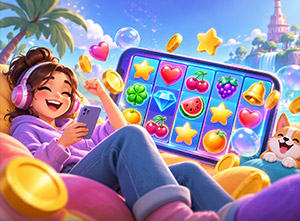
Pragmatic Play introduced POP on 31 July 2026, evolving its earlier Fat Panda brand into a dedicated sub-brand aimed at casual and beginner players. Many modern slots compete through additional mechanics, bonus features, multipliers and increasingly elaborate variations. POP takes a different route. Pragmatic Play positions POP around simpler mechanics, faster animations, more frequent wins and a lighter visual style, combining adaptations of familiar franchises with original games.
The question is not whether complex slots are going away. It is why a major supplier sees value in making some of its most recognisable games easier to understand.
What Is Pragmatic Play POP?
Pragmatic Play POP is a separate game label within the provider's portfolio, developed from the Fat Panda brand and positioned around straightforward, accessible play. Pragmatic Play describes the range as designed for newer and more casual players, emphasising streamlined reels, intuitive mechanics, faster animations, high hit rates and colourful, softer graphics.
That makes POP more than a new skin for existing Pragmatic Play slots. It represents a different design brief.
The first announced rollout includes POP interpretations of Gates of Olympus, Sweet Bonanza, Zeus vs Hades and Starlight Princess. Gates of Olympus POP launched on 31 August as the first familiar franchise to receive the treatment, while Pragmatic Play has announced that the other properties will also be adapted for POP. Existing Fat Panda titles are being moved under the new identity as well.
The important distinction is that POP is not simply a sequence of sequels. It is a way to reuse familiar intellectual property while changing how quickly players can read and understand the game in front of them.
What Actually Changes in a POP Slot?
The clearest example so far is Gates of Olympus POP. The original Gates of Olympus uses a 30-position, six-reel-by-five-row setup built around pay-anywhere wins, tumbling symbols and multiplier mechanics. Gates of Olympus POP compresses that idea into a 3×5 portrait-format grid.
That smaller layout changes how much information is presented at once. Instead of asking a player to scan 30 positions, the POP version works with 15. Wins are awarded when five or more matching royal symbols appear anywhere on the grid, and winning symbols tumble away so replacements can fall into place.
The simplification does not strip out every recognisable feature. Tumbling reels remain. Multiplier symbols can still appear, with values of up to 1,000x, and three or more scatter symbols trigger 15 free spins. The bonus game can also extend when additional scatters land. Pragmatic Play has therefore kept several mechanics associated with the wider Gates of Olympus franchise while reducing the size and visual density of the play area.
That is a useful way to understand the POP idea more broadly. Simpler slot mechanics do not have to mean featureless games. The design goal is to lower the amount of information a new player must process before the basic loop makes sense.
Pragmatic Play also describes POP around more frequent wins and faster animations. Those are brand-level design principles, not a claim that every POP title will use identical mathematics or exactly the same feature set.
More frequent payouts do not necessarily mean a higher return to player (RTP), lower volatility or a greater chance of finishing a session ahead. A payout can also be smaller than the amount staked. Simpler presentation should not be confused with lower financial risk.
Why Slot Developers Are Designing for Casual Players
POP enters a market where players browsing slots online can encounter everything from mechanically dense games with several bonus systems to streamlined titles designed to be understood quickly. That range helps explain why Pragmatic Play sees room for a separate label aimed specifically at casual players.
Accessibility is not only about having fewer rules; it is also about how quickly a player can recognise what counts as a win, what triggers a feature and what information must be tracked from one spin to the next.
Familiarity can make feature-rich slots easier to navigate, but their additional mechanics create more to learn at the beginning. A regular player may be comfortable tracking multiple meters, multiplier states, bonus symbols and alternate modes. Someone who plays only occasionally may simply want to know what creates a win and what happens next.
Streamlined interfaces reduce that learning burden. Clear animations and uncluttered layouts may make outcomes easier to follow, while compact grids can reduce the amount of information competing for space on a mobile screen. Familiar mechanics can also help players understand a game without working through several layers of rules before getting a sense of how it operates.
For games offered in Great Britain, presentation speed must still comply with Gambling Commission rules. Online slots must allow at least 2.5 seconds between the start of one game cycle and the start of the next, and player-controlled features such as turbo and quick spin are prohibited.
The rule remains an active enforcement issue. In June 2026, the Gambling Commission announced that Stakelogic would pay £122,835 after an investigation found multiple games operating below the required 2.5-second minimum.
This does not mean one design style is automatically better. Different players may want different levels of complexity. POP is interesting because Pragmatic Play is treating that difference as a product-design question rather than expecting one format to serve everyone.
Familiar Franchises Can Make New Formats Easier to Recognise
There is also a strategic reason to simplify games that already have recognisable names.
Gates of Olympus, Sweet Bonanza and Starlight Princess come with established characters, themes and visual identities. A player who recognises Zeus, the candy-filled world of Sweet Bonanza or the look of Starlight Princess does not need to learn an entirely new game identity at the same time as a new ruleset.
That gives Pragmatic Play room to alter the experience underneath the branding. The company can change the grid, pacing, animation style and mechanical density while keeping enough visual continuity for the game to feel familiar.
Familiar branding may reduce the amount of new information a player encounters, although how easily a game is understood still depends on its rules and presentation.
That does not imply POP versions will replace the originals. The more useful way to view them is as alternative interpretations. One player may prefer the fuller, more layered version of a franchise, while another may prefer a compact version that communicates its rules more quickly. Reusing known properties lets the provider address both preferences without starting from zero each time.
What POP Could Signal for the Future of Online Slots
POP suggests that slot development does not have to move in only one direction. Providers can differentiate games through additional features and increasingly elaborate bonus structures, but Pragmatic Play's new sub-brand shows another option: designing separate experiences around how much complexity different players want.
There are limits to how much can be inferred from one provider's strategy. Complex online slots are not disappearing, and POP is still a new label with only the first part of its roadmap in the market. It is too early to treat the launch as proof of an industry-wide transformation.
The more important signal is segmentation. Instead of assuming every slot player wants the same density of features, providers can build different experiences around different styles of play. POP's significance is that Pragmatic Play is applying that logic to some of its best-known franchises rather than confining simpler design to entirely separate games.
By GamesAndCasinoRelated News
-
Read Full Article
 Games & Casino News
Pragmatic Play Releases Sweet Bonanza 2500 Slot
Games & Casino News
Pragmatic Play Releases Sweet Bonanza 2500 Slot
Pragmatic Play has expanded one of its best-known online slot series with the release of Sweet Bonanza 2500, a new version of its candy-themed game built around higher multiplier potential and a wider set of feature options.
-
Read Full Article
 Games & Casino News
Pragmatic Play Unveils Gates of Olympus Xmas 1000
Games & Casino News
Pragmatic Play Unveils Gates of Olympus Xmas 1000
Pragmatic Play unveils the festive Gates of Olympus Xmas 1000, blending holiday charm with familiar slot mechanics and impressive multipliers.